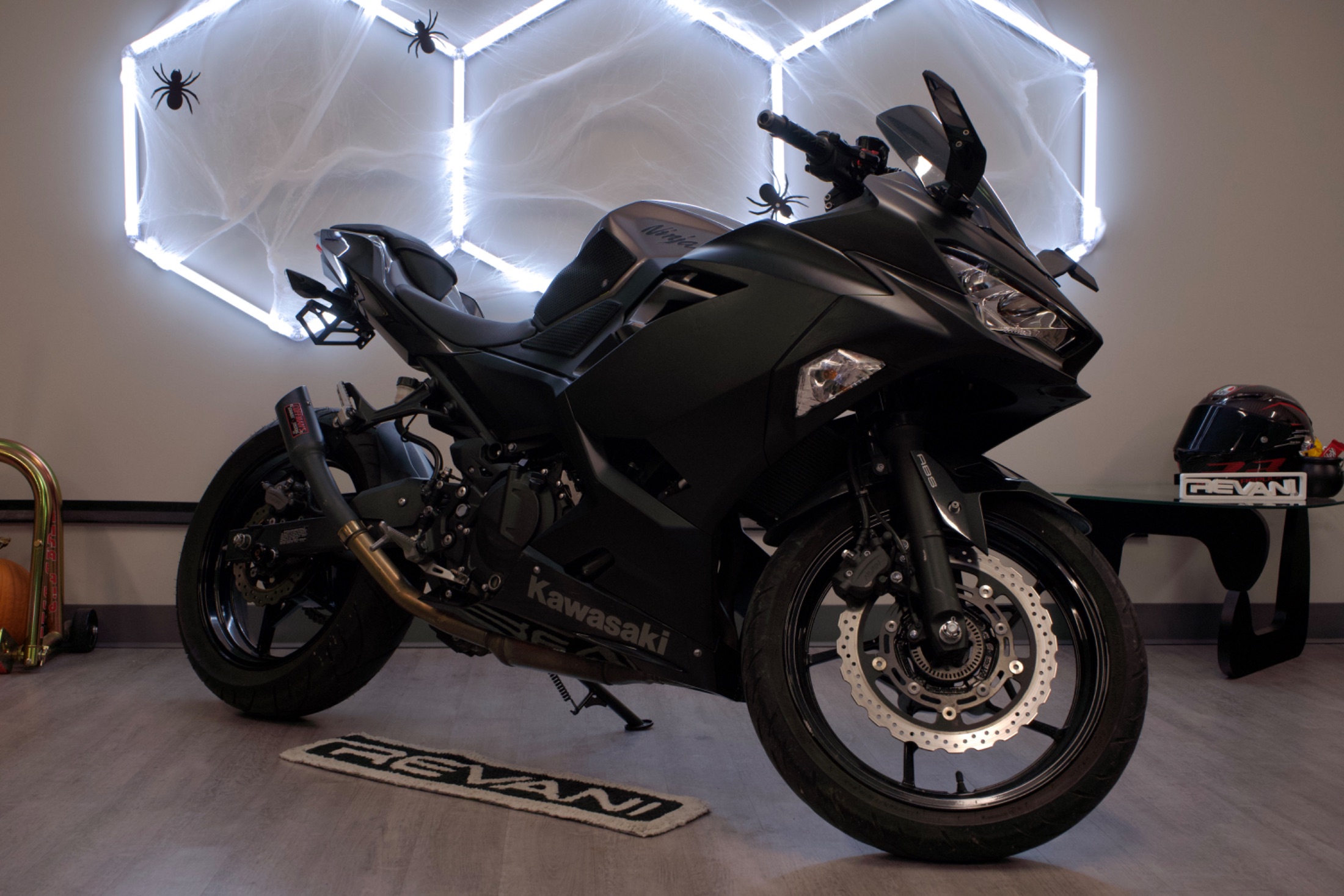
2021 KAWASAKI Ninja 400
ABS
7,442 mi
399cc
2021
$4,890
Sportbikes
The Ninja 400 is Kawasaki’s 399cc parallel-twin entry sportbike, sold in the US from 2018 through 2023. It replaced the Ninja 300 with a new engine, a lighter steel trellis frame and an assist-and-slipper clutch, and it kept a low 30.9 in seat throughout its run.
This guide covers what to know when shopping for a used Kawasaki Ninja 400, with any matching motorcycles from Revani’s inventory in Addison, TX, which serves riders across Dallas–Fort Worth.
1 used Kawasaki Ninja 400 currently listed at Revani in Addison, TX.
Rider’s 2018 first ride describes the Ninja 400 as new from the ground up, not a bored-out Ninja 300. The DOHC twin grew by 103cc to 399cc with a 70.0 × 51.8 mm bore and stroke, breathing through a downdraft intake and a 5.8-liter airbox. Kawasaki claimed the assist-and-slipper clutch needed 20% less lever effort than the 300’s.
The chassis is a high-tensile steel trellis that uses the engine as a stressed member, with the swingarm mounted to the engine. It carries a 41mm fork, a preload-adjustable back-link shock and a 310mm front disc with a two-piston caliper. Kawasaki claimed 366 lb wet for the 2018 ABS model, and Rider reported that as more than 17 lb lighter than the Ninja 300.
Kawasaki offered the Ninja 400 with or without ABS for its whole US run. For 2024, the Ninja 500 took its place in the lineup with a longer-stroke 451cc version of the same twin in a largely carried-over chassis. Anyone shopping used 2018–2023 models is choosing between ABS and non-ABS bikes and among several KRT and special-paint editions.
Kawasaki lists a 30.9 in seat height for 2021–2023, unchanged from the 2018 claim. Rider reported that the bars sit 15mm closer to the rider than on the Ninja 300, with footpegs 9mm farther forward and 9mm lower. The result is a mild sport crouch: sporty enough to feel like a Ninja but relaxed enough for new riders and short commutes.
The Ninja 400 is aimed at newer riders, commuters on a budget and anyone who wants a light, inexpensive sportbike for back roads or track days. Its low seat, 366 lb claimed curb weight and light clutch make it easy to manage. Its non-adjustable fork, single front disc and 3.7 gal tank limit it once riders want more highway range or harder track pace.
| Specification | Value | Applies to | What the figure is |
|---|---|---|---|
| Displacement | 399 cc[1] | 2018 · Base and ABS · US | Manufacturer-claimed (reported by Rider) |
| Bore × stroke | 70.0 × 51.8 mm[1] | 2018 · Base and ABS · US | Manufacturer specification (reported by Rider) |
| Curb weight | 366 lb[1] | 2018 · ABS · US | Wet weight (manufacturer-claimed, reported by Rider) |
| Curb weight | 362 lb[1] | 2018 · Non-ABS · US | Wet weight (manufacturer-claimed, reported by Rider) |
| Seat height | 30.9 in[1] | 2018 · Base and ABS · US | Manufacturer-claimed (reported by Rider) |
| Fuel capacity | 3.7 gal[1] | 2018 · Base and ABS · US | Manufacturer-claimed (reported by Rider) |
| Wheelbase | 53.9 in[1] | 2018 · Base and ABS · US | Manufacturer-claimed (reported by Rider) |
| ABS | Available on ABS models(optional)[1] Rider lists $4,999 non-ABS and $5,299–$5,499 for ABS models. | 2018 · ABS models · US | Manufacturer specification (reported by Rider) |
| Specification | Value | Applies to | What the figure is |
|---|---|---|---|
| Displacement | 399 cc[2],[3],[4] | 2021–2023 · All · US | Manufacturer-claimed |
| Engine | 4-stroke, parallel twin, DOHC[2],[3],[4] | 2021–2023 · All · US | Manufacturer specification |
| Cooling | Liquid-cooled[2],[3],[4] | 2021–2023 · All · US | Manufacturer specification |
| Transmission | 6-speed[2],[3],[4] | 2021–2023 · All · US | Manufacturer specification |
| Final drive | Sealed chain[2],[4] | 2021–2023 · All · US | Manufacturer specification |
| Curb weight | 368.2 lb[2] | 2021 · ABS · US | Curb weight (manufacturer-claimed; fluids and full tank) |
| Curb weight | 366.0 lb[3],[4] | 2022–2023 · ABS · US | Curb weight (manufacturer-claimed; fluids and full tank) |
| Curb weight | 361.6 lb[4] | 2023 · Non-ABS · US | Curb weight (manufacturer-claimed; fluids and full tank) |
| Seat height | 30.9 in[2],[3],[4] | 2021–2023 · All · US | Manufacturer-claimed |
| Fuel capacity | 3.7 gal[2],[3],[4] | 2021–2023 · All · US | Manufacturer-claimed |
| Wheelbase | 53.9 in[2],[3],[4] | 2021–2023 · All · US | Manufacturer-claimed |
| Front tire | 110/70-17[2],[3],[4] | 2021–2023 · All · US | Manufacturer specification |
| Rear tire | 150/60-17[2],[3] | 2021–2022 · All · US | Manufacturer specification |
| Front suspension | 41mm hydraulic telescopic fork; 4.7 in travel[2],[4] | 2021–2023 · All · US | Manufacturer specification |
| Front brake | Single 310mm petal-type disc, 2-piston caliper (semi-floating disc listed from 2022)[2],[3],[4] | 2021–2023 · All · US | Manufacturer specification |
| ABS | ABS on ABS-equipped models only(optional)[4] | 2023 · ABS models · US | Manufacturer specification |
The Ninja 400 replaced the Ninja 300 for 2018 with a new 399cc twin and a lighter trellis chassis, and it stayed largely unchanged through 2023 apart from colors and editions.
NHTSA campaign 20V-774 covers certain 2021 Ninja 400 (EX400H), Ninja 400 ABS (EX400G) and Z400 ABS models. Improper heat treatment may have left the camshaft chain tensioner too weak, and if it is damaged the engine can stall. Owners were told not to ride until dealers replaced the tensioner. Confirm by VIN that it was done.[5]
ABS and non-ABS Ninja 400s were sold side by side and look very similar. Kawasaki lists the 2023 non-ABS bike 4.4 lb lighter than the ABS model. Check for the ABS hardware or the model designation before relying on a listing.[4],[1]
On the Ninja 400 the engine is a stressed member of the frame and the swingarm mounts to the engine, so impact damage to the engine cases matters more than cosmetic scuffs. Ask whether the bike has been dropped or used on track, and inspect the bodywork, bars, levers and engine covers.[1]
Kawasaki’s spec sheets tell owners to follow the maintenance schedule in the Owner’s Manual. Ask for dated oil-change and scheduled-service records, plus paperwork for recall 20V-774 on 2021 bikes. This page does not list the valve-clearance interval because the manual was not reviewed.[4],[5]
The 2024-on successor uses a longer-stroke 451cc version of the same twin in a nearly identical chassis, with an LCD or TFT dash in place of the 400’s analog-hybrid cluster.
Yamaha’s small parallel-twin sportbike was the rival Kawasaki benchmarked in its 2018 Ninja 400 acceleration claims.
A 399cc inline-four from Kawasaki with an inverted fork, traction control and a 16,000 rpm redline, but about 48 lb heavier and considerably more expensive.
Revani is a used-motorcycle dealership at 4275 Kellway Circle Suite 114, Addison, TX 75001, serving buyers across Dallas–Fort Worth.
Call or text 469-444-9561 or email info@revanisportbikes.com.
Contact page and showroom hours · All inventory · Sell your motorcycle
Sources retrieved 2026-11-14. Specifications are manufacturer-published unless a row says otherwise; confirm the exact equipment of any individual motorcycle before purchase.