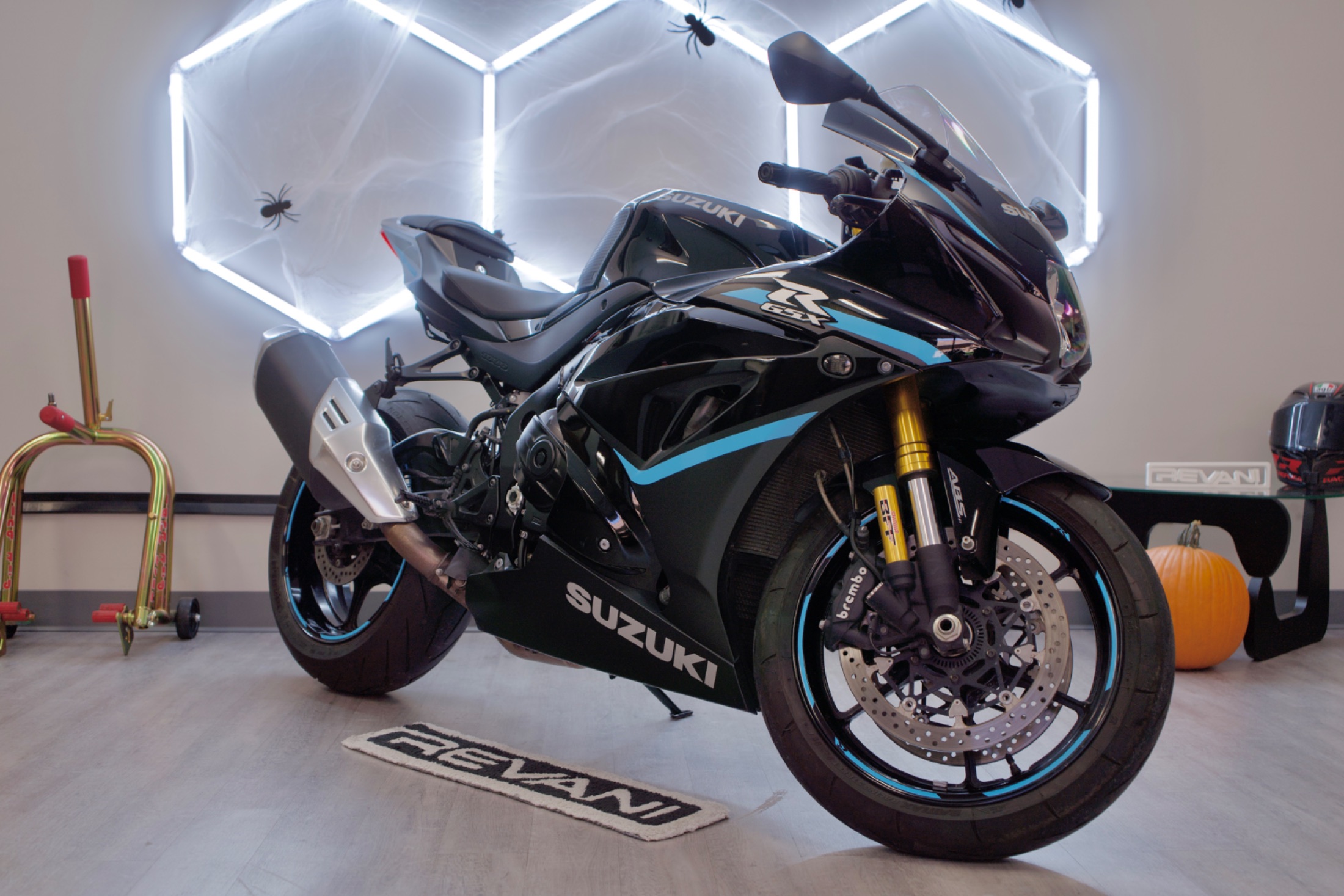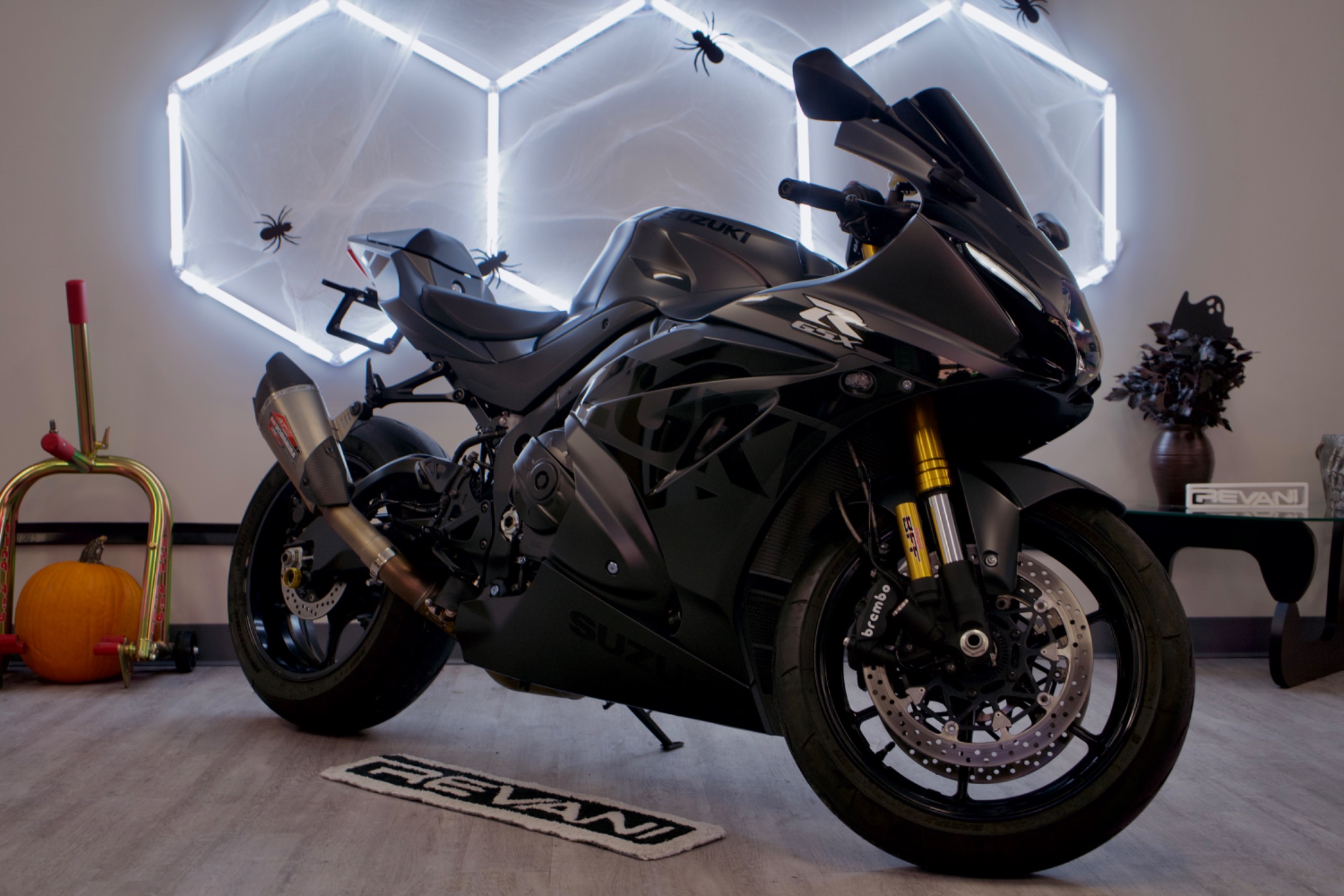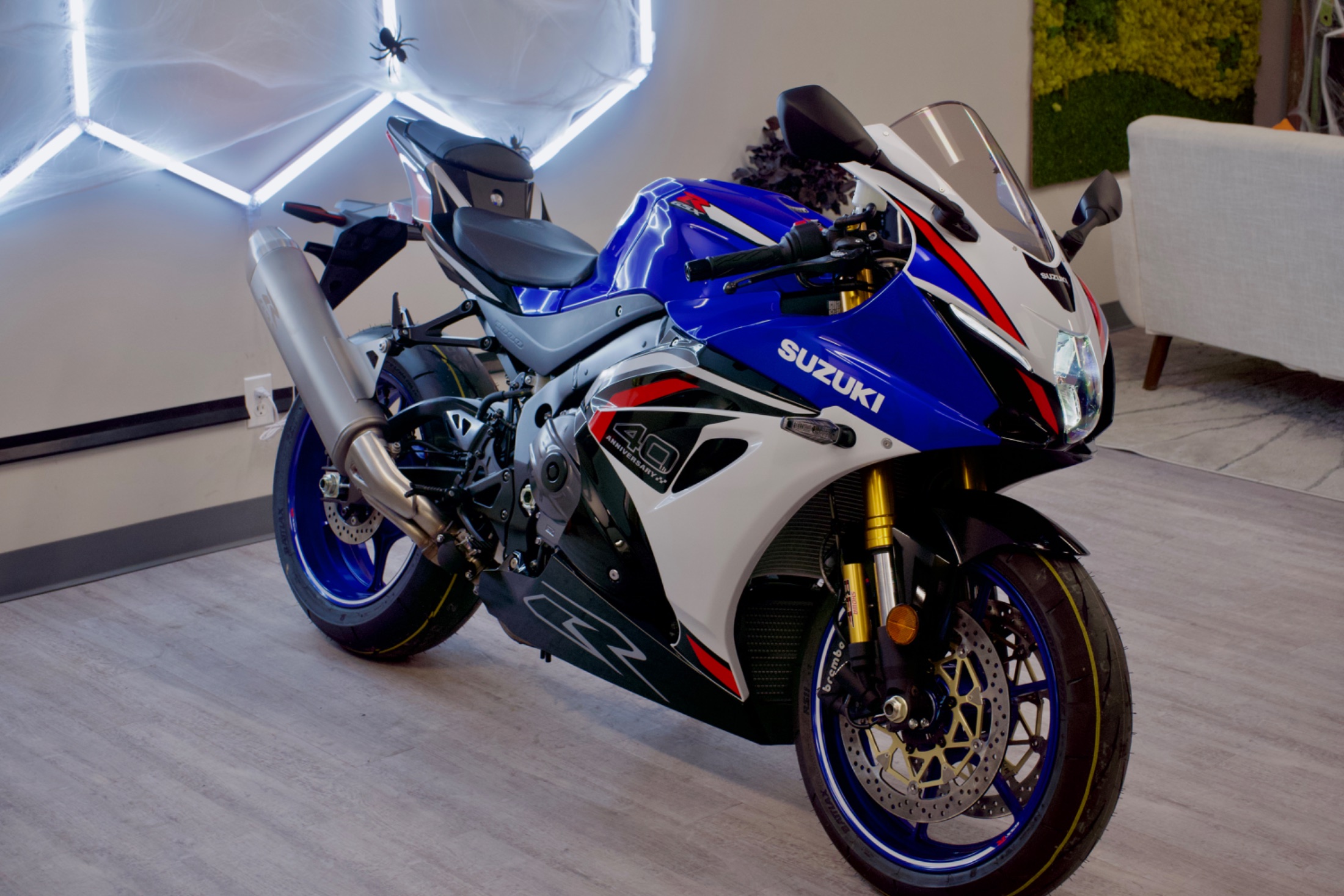
2027 SUZUKI GSX-R1000
40th anniversary
0 mi
1000cc
2027
$18,990
Sportbikes
The GSX-R1000 is Suzuki’s liter-class inline-four superbike, sold since the 2001 model year and redesigned around a variable-valve-timing engine for 2017. From 2017 Suzuki has offered it as a base model and as the GSX-R1000R, which adds Showa Balance Free suspension and launch control; a winglet-equipped GSX-R1000RS joined the US range for 2027.
This guide covers what to know when shopping for a used Suzuki GSX-R1000, with any matching motorcycles from Revani’s inventory in Addison, TX, which serves riders across Dallas–Fort Worth.
Also written as: GSX-R1000R, GSXR1000.
3 used Suzuki GSX-R1000 currently listed at Revani in Addison, TX.
The first GSX-R1000 used a 988 cc four derived from GSX-R750 thinking, with a beam frame closely related to the 750’s. Suzuki enlarged the engine to 998.6 cc for 2005 and then went to a shorter-stroke 999 cc design for 2009, the year it also adopted a Showa Big Piston Fork. That 2009 engine carried on, with lighter pistons and Brembo monobloc calipers arriving for 2012, until the 2017 redesign.
The 2017 engine is the one most buyers now shop. Motorcycle.com reported Suzuki’s claim of 199 hp at the crankshaft, a finger-follower valvetrain, a centrifugal variable-valve-timing mechanism that retards cam timing above about 10,000 rpm, and a rev ceiling raised to 14,500 rpm. A six-axis IMU feeds a ten-level traction control system and Suzuki’s Motion Track ABS logic, which limits rear-wheel lift under hard braking.
The split between trims is mostly chassis and electronics. The base bike uses a Showa Big Piston fork and a remote-reservoir shock; the R uses a Showa Balance Free fork and BFRC-lite shock, an adjustable swingarm pivot and launch control, and it weighs about 1 kg more in Suzuki’s 2025 US figures. For 2027 Suzuki raised compression to 13.8:1, fitted a new cylinder head and 4-2-1 exhaust, a Bosch IMU and a lithium-ion battery, and added Lift Limiter and Roll Torque Control under a Smart TLR heading.
This is a committed superbike posture: clip-on bars below the top triple clamp, high rear-set pegs and, on the 2017-and-later bikes, a 32.5-inch seat height in Suzuki’s US figures. Weight sits on the wrists at low speed and the bike only feels balanced once airflow takes some load off the rider’s upper body, so long highway stints are tiring compared with a sport-tourer. The pre-2009 bikes list a lower 31.9-inch seat from 2005 on, but the reach is similar.
The GSX-R1000 is built first for fast road riding and track days, with the R trim’s adjustable swingarm pivot and Balance Free suspension aimed squarely at circuit use. It is street-legal and carries a passenger seat, but the short-range 4.2-gallon tank on 2017-and-later bikes, firm seat and aggressive ergonomics make it a weekend or track tool rather than a commuter.
| Specification | Value | Applies to | What the figure is |
|---|---|---|---|
| Displacement | 988 cc[6],[7] | 2003–2004 · Base · US | Manufacturer-listed |
| Bore × stroke | 73.0 × 59.0 mm[6],[7] | 2003–2004 · Base · US | Manufacturer-listed |
| Dry weight | 370 lb[6],[7] Suzuki lists 168 kg (370 lb). | 2003–2004 · Base · US | Dry weight (manufacturer-claimed) |
| Seat height | 830 mm[6],[7] Suzuki’s page prints 830 mm alongside “32.3 in.”; 830 mm converts to about 32.7 in. | 2003–2004 · Base · US | Manufacturer-claimed |
| Fuel capacity | 4.8 gal[6],[7] 18 L. | 2003–2004 · Base · US | Manufacturer-claimed |
| Wheelbase | 55.5 in[6],[7] 1410 mm. | 2003–2004 · Base · US | Manufacturer-claimed |
| Transmission | 6-speed, constant mesh[6],[7] | 2003–2004 · Base · US | Manufacturer-listed |
| Specification | Value | Applies to | What the figure is |
|---|---|---|---|
| Displacement | 998.6 cc[8] The archived 2006 spec page omits the engine line; its bore and stroke match 2005. | 2005 · Base · US | Manufacturer-listed |
| Bore × stroke | 73.4 × 59.0 mm[8],[9] | 2005–2006 · Base · US | Manufacturer-listed |
| Dry weight | 365 lb[8],[9] Suzuki lists 166 kg (365 lb). | 2005–2006 · Base · US | Dry weight (manufacturer-claimed) |
| Seat height | 31.9 in[8],[9] 810 mm. | 2005–2006 · Base · US | Manufacturer-claimed |
| Fuel capacity | 4.8 gal[8],[9] 18 L. | 2005–2006 · Base · US | Manufacturer-claimed |
| Wheelbase | 55.3 in[8],[9] 1405 mm. | 2005–2006 · Base · US | Manufacturer-claimed |
| Specification | Value | Applies to | What the figure is |
|---|---|---|---|
| Displacement | 999 cc[10],[11] | 2007–2008 · Base · US | Manufacturer-listed (bore and stroke unchanged from 2005–2006) |
| Dry weight | 379 lb[10],[11] Suzuki lists 172 kg (379 lb); the 2008 page lists 173 kg (381 lb) for California models. | 2007–2008 · Base (49-state) · US | Dry weight (manufacturer-claimed) |
| Seat height | 31.9 in[10],[11] | 2007–2008 · Base · US | Manufacturer-claimed |
| Fuel capacity | 4.8 gal[10] 18 L. | 2007 · Base · US | Manufacturer-claimed |
| Fuel capacity | 4.6 gal[11] 17.5 L. | 2008 · Base · US | Manufacturer-claimed |
| Wheelbase | 55.7 in[10],[11] 1415 mm. | 2007–2008 · Base · US | Manufacturer-claimed |
| Specification | Value | Applies to | What the figure is |
|---|---|---|---|
| Displacement | 999 cc[12],[13] | 2009, 2011 · Base · US | Manufacturer-listed |
| Bore × stroke | 74.5 × 57.3 mm[12],[13] | 2009, 2011 · Base · US | Manufacturer-listed |
| Curb weight | 448 lb[12] Suzuki lists 203 kg (448 lb). | 2009 · Base · US | Curb weight (manufacturer-claimed) |
| Curb weight | 452 lb[13] Suzuki lists 205 kg (452 lb). | 2011 · Base · US | Curb weight (manufacturer-claimed) |
| Seat height | 31.9 in[12],[13] | 2009, 2011 · Base · US | Manufacturer-claimed |
| Fuel capacity | 4.6 gal[12],[13] 17.5 L. | 2009, 2011 · Base · US | Manufacturer-claimed |
| Rear tire | 190/50ZR17M/C (73W), tubeless[12],[13] | 2009, 2011 · Base · US | Manufacturer-listed |
| Specification | Value | Applies to | What the figure is |
|---|---|---|---|
| Peak power | 199 @ 13,200 rpm hp[15] | 2017 · Base and R (shared engine) · US | Manufacturer-claimed peak at crankshaft, as reported by Motorcycle.com |
| Peak torque | 86 @ 10,800 rpm lb-ft[15] | 2017 · Base and R (shared engine) · US | Manufacturer-claimed, as reported by Motorcycle.com |
| Front suspension | Showa Big Piston Fork[15] | 2017 · Base · US | Manufacturer specification, as reported by Motorcycle.com |
| Front suspension | Showa Balance Free Fork (BFF), fully adjustable[15] | 2017 · GSX-R1000R · US | Manufacturer specification, as reported by Motorcycle.com |
| ABS | Optional (separate ABS model)(optional)[15] Motorcycle.com lists $14,599 without ABS and $14,999 with ABS. | 2017 · Base · US | US model lineup at launch |
| ABS | Cornering-capable ABS[15] | 2017 · GSX-R1000R · US | US model lineup at launch |
| Quickshifter and launch control | Bi-directional quickshifter and launch control[15] | 2017 · GSX-R1000R · US | Equipment added on the R trim |
| Specification | Value | Applies to | What the figure is |
|---|---|---|---|
| Displacement | 999.8 cc[4],[5] | 2025 · Base and R · US | Manufacturer-listed |
| Bore × stroke / compression | 76.0 × 55.1 mm, 13.2:1[4],[5] | 2025 · Base and R · US | Manufacturer-listed |
| Curb weight | 443 lb[4] Suzuki lists 201 kg (443.0 lb). | 2025 · Base · US | Curb weight (manufacturer-claimed) |
| Curb weight | 445 lb[5] Suzuki lists 202 kg (445.0 lb). | 2025 · GSX-R1000R · US | Curb weight (manufacturer-claimed) |
| Seat height | 32.5 in[4],[5] 825 mm. | 2025 · Base and R · US | Manufacturer-claimed |
| Fuel capacity | 4.2 gal[4],[5] 16.0 L. | 2025 · Base and R · US | Manufacturer-claimed |
| Wheelbase | 55.9 in[4],[5] 1420 mm. | 2025 · Base and R · US | Manufacturer-claimed |
| Front brakes | Brembo Monobloc 4-piston, twin disc, ABS-equipped[4],[5] | 2025 · Base and R · US | Manufacturer-listed |
| ABS | Motion Track ABS (pitch-sensitive on base, lean-sensitive on R)[4],[5] | 2025 · Base and R · US | Manufacturer feature description |
| Quickshifter | Bi-directional quick shift system[4],[5] | 2025 · Base and R · US | Manufacturer feature description |
| Rear tire | 190/55ZR17M/C (75W), tubeless[4],[5] | 2025 · Base and R · US | Manufacturer-listed |
| Specification | Value | Applies to | What the figure is |
|---|---|---|---|
| Compression ratio | 13.8:1[1],[2],[3] Raised from 13.2:1. | 2027 · Base, R and RS · US | Manufacturer-listed |
| Curb weight | 448 lb[1],[2],[3] Suzuki lists 203 kg (448.0 lb) for all three. | 2027 · Base, R and RS · US | Curb weight (manufacturer-claimed) |
| Seat height | 32.5 in[1],[2],[3] | 2027 · Base, R and RS · US | Manufacturer-claimed |
| Fuel capacity | 4.2 gal[1],[2],[3] | 2027 · Base, R and RS · US | Manufacturer-claimed |
| Rider aids | Bosch IMU, traction control with Lift Limiter and Roll Torque Control (Smart TLR), Motion Track ABS, bi-directional quickshifter, launch control[1],[2],[3] | 2027 · Base, R and RS · US | Manufacturer feature description |
| Front suspension | Showa Big Piston Fork (base); Showa BFF (R and RS)[1],[2],[3] | 2027 · Base, R and RS · US | Manufacturer feature description |
| RS-specific equipment | Carbon-fiber winglets and color-matched solo seat cowl[3] Suzuki lists CF-look winglets as an optional accessory for the base and R. | 2027 · GSX-R1000RS · US | Manufacturer feature description |
The first GSX-R1000 paired a 988 cc fuel-injected four with a beam frame based on the GSX-R750’s. A 2003 update brought radial-mount front brakes and a 32-bit ECU.
A larger-bore 998.6 cc engine, slipper clutch and lighter, more compact chassis arrived for 2005. The 2007 model added selectable power modes and an electronically controlled steering damper, and gained weight with a stacked twin-muffler exhaust.
An all-new, more oversquare 999 cc engine with 12.8:1 compression, a shorter wheelbase, longer swingarm and a Showa Big Piston Fork. The 2012 revision added lighter pistons and Brembo monobloc calipers and dropped the twin mufflers.
A new engine with finger-follower valve actuation, centrifugal variable valve timing and a 14,500 rpm redline, plus IMU-based traction control and Motion Track ABS. The R trim adds Showa BFF/BFRC-lite suspension, launch control and, at launch, the quickshifter.
Suzuki revised the engine for EPA, CARB and Euro 5+ with a new cylinder head, larger valves, 13.8:1 compression, stronger crankcases and crank, and an all-new 4-2-1 exhaust, and added a carbon-winglet RS trim.
NHTSA campaign 13V449 covers 2005–2013 GSX-R1000s: corrosion inside the front master cylinder, combined with old brake fluid, can reduce front brake pressure. The remedy is a replacement master cylinder. Ask for proof it was done, and check the fluid’s age regardless.[18],[20]
Campaign 14V629 replaces the left chain adjuster on 2009–2014 bikes after missed upshifts could let the axle move. Earlier campaigns include 07V362 (2007 idle-speed-control valve and ECM) and 09V022, a frame inspection and reinforcement brace for 2005–2006 bikes. NHTSA also returns 12V231 (side-stand switch bolts) for 2009–2011 queries, though its summary describes 2012 bikes, so check the specific VIN.[18],[19],[20]
Campaign 18V064 replaces the ECM and inspects the chain and sprockets after a missed 1–2 shift could over-rev the engine and stress the chain. Campaign 18V694 replaces a possibly twisted fuel-pump O-ring and the tank inner vessel to prevent fuel leaks. Check any GSX-R1000 by VIN at nhtsa.gov, since other years can have campaigns too.[21],[22]
Suzuki service bulletin GS/GSX/GSX-R No. 260 gives updated EXCV cable lengths and voltage settings for 2017–2023 GSX-R1000/R models, and says a loud metallic clatter from the exhaust when shifting into gear points to improper EXCV cable clearance from lack of maintenance. Listen for it on a test start.[14]
On 2017-and-later bikes, the R is identified by Showa BFF fork canisters mounted at the axle holders, matching gold-anodized fork tubes. For 2017 base models, confirm whether the bike is the ABS version, since it was optional at launch.[2],[15]
Yamaha’s liter-class superbike and the most direct Japanese rival to the GSX-R1000 across most of its production run.
Kawasaki’s equivalent track-focused liter bike, a direct cross-shop for 2017-and-later GSX-R1000R buyers comparing electronics packages.
A European liter superbike that shoppers often weigh against the GSX-R1000R when comparing electronics and suspension packages.
Suzuki’s smaller GSX-R uses a 750 cc four in a lighter 600-class chassis and lacks the 1000’s IMU-based rider aids.
Revani is a used-motorcycle dealership at 4275 Kellway Circle Suite 114, Addison, TX 75001, serving buyers across Dallas–Fort Worth.
Call or text 469-444-9561 or email info@revanisportbikes.com.
Contact page and showroom hours · All inventory · Sell your motorcycle
Sources retrieved 2026-11-14. Specifications are manufacturer-published unless a row says otherwise; confirm the exact equipment of any individual motorcycle before purchase.